
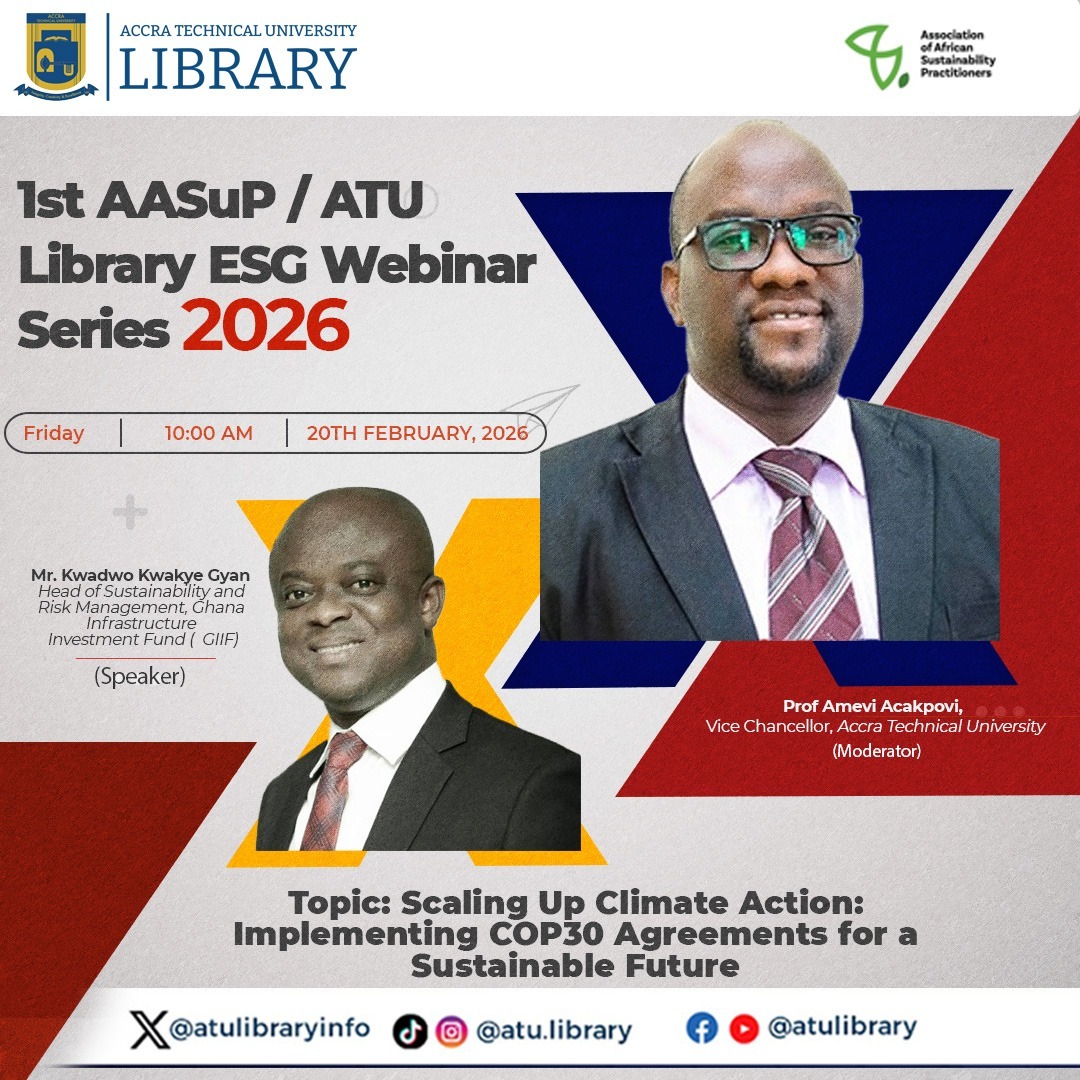
Scaling Climate Action: Highlights from the First AASUP/ATU Library Webinar Series 2026
The first AASUP/ATU Library Webinar Series for 2026 was held on Friday, 20th February 2026. The event featured the Vice-Chancellor of Accra Technical University (ATU), Prof. Amevi Acakpovi as the Chairperson for the event and Mr. Kwadwo Kwakye Gyan, as the keynote speaker. The webinar attracted close to fifty participants from diverse professional backgrounds, including academia, banking, health, and other industries. As the inaugural webinar in the series, the level of participation was encouraging, and the interactive discussions demonstrated a strong interest among participants in sustainability and climate-related issues.
In his introductory remarks, Prof. Amevi Acakpovi emphasized that the global climate conversation has shifted from mere dialogue to action, implementation, accountability, and measurable impact. According to him, major financial institutions and corporate organizations are increasingly required to submit sustainability reports that are endorsed by experts in the field. He also highlighted the role of Accra Technical University in addressing climate challenges through technical innovation, leadership responsibility, and opportunities for sustainable development.
The theme for the webinar was “Scaling Up Climate Action: Implementing COP30 Agreements for a Sustainable Future.” The keynote speaker, Mr. Kwadwo Kwakye Gyan, is the Head of Sustainability and Risk Management at the Ghana Infrastructure Investment Fund (GIIF). In this role, he leads the Environmental, Social and Governance (ESG) agenda, climate strategy, and risk governance initiatives at the institution. Mr. Gyan has over twenty-four years of professional experience spanning banking, project financing, and environmental risk management. Throughout his career, he has played key roles in climate financing initiatives, Green Climate Fund accreditation processes, and infrastructure resilience programmes. He is a Chartered Environmentalist and a Certified Risk Analyst and holds executive sustainability certifications from the Massachusetts Institute of Technology (MIT), Yale University, and Oxford University.
During his presentation, Mr. Gyan focused on the Conference of the Parties (COP), particularly the key outcomes and implementation mechanisms associated with COP30. He discussed the major challenges and pillars required for implementation, as well as the broader implications for Africa and the strategic way forward for Ghana and the continent.
To set the context, Mr. Gyan explained the concept of the COP and what COP30 represents, particularly for the Global South. He highlighted four key focus areas of COP30: adaptation, climate financing, loss and damage, and energy transition. While earlier COP meetings focused strongly on mitigation strategies to reduce greenhouse gas emissions, there has been a noticeable shift toward adaptation in recent years. This shift reflects the growing recognition that vulnerable countries – many of which are in the developing world, including Ghana – are already experiencing severe climate impacts despite contributing relatively little to global emissions. These impacts are evident in several sectors of the Ghanaian economy, particularly agriculture, where some crops that previously thrived in the country are no longer viable due to climate variability. Consequently, COP30 emphasized increased adaptation financing and stronger national adaptation plans for vulnerable countries, in line with the Global Goal on Adaptation (GGA) under the Paris Agreement.
Addressing the issue of climate financing, Mr. Gyan noted that many developing countries face significant challenges in accessing adequate financial resources to support climate adaptation and energy transition. Although these countries are expected to transition toward renewable energy systems, they often lack sufficient funding, and financial pledges from developed countries have not always materialized as expected. At COP30, however, parties agreed to triple adaptation financing by 2035 from the existing annual target of USD 100 billion. He explained that major sources of global adaptation funding include multilateral development banks, bilateral donor agencies, and climate funds designed to support countries facing climate-related challenges. He also mentioned the Vulnerable Forum, a coalition of climate-vulnerable developing countries headquartered in Accra, which advocates for equitable access to climate financing and the role they were playing in helping their member countries access funding and also their role in ensuring equitable financing.
Another important development highlighted during the presentation was the Loss and Damage Fund, recently established at COP30. This fund is intended to address non-reversible climate impacts such as displaced communities due to floods or droughts, destruction of livelihoods, loss of cultural heritage, and economic losses resulting from extreme weather events. After several years of negotiations since COP27, the fund was finally accepted and formally established to support vulnerable nations experiencing irreversible climate-related damages.
On the issue of energy transition, Mr. Gyan explained that the global energy landscape is gradually shifting from fossil fuel-based systems toward cleaner energy sources such as solar, hydro, and wind power. Discussions at the COP level emphasize the importance of a just and equitable energy transition, ensuring that climate actions protect livelihoods and jobs while providing financial support to developing countries to facilitate their transition to cleaner energy systems.
In discussing strategies for scaling up climate action, Mr. Gyan stressed that Ghana and Africa must move beyond pilot projects toward systemic implementation. This requires transitioning from fragmented interventions to coordinated platforms that embed climate action within national systems. He highlighted the need to integrate climate resilience into infrastructure planning, noting that the rapid deterioration of some infrastructure projects, such as roads in Ghana, is partly due to the absence of climate-resilient design. Furthermore, he emphasized the importance of shifting from external dependence to domestic capacity, both in terms of financial resources and technical expertise.
Mr. Gyan also pointed out that Ghana must improve its feasibility studies and project preparation processes in order to develop bankable projects – projects with the financial credibility and repayment potential required to attract investment. Without such preparation, it becomes difficult for institutions to access the climate funding available globally. He further noted that Ghana currently faces challenges such as limited fiduciary capacity, inadequate project preparation mechanisms, insufficient ESG and safeguard systems, and a limited number of accredited institutions capable of submitting proposals to global climate funds.
Regarding the implications of COP30 for Africa and Ghana, Mr. Gyan suggested that countries on the continent should focus on developing large-scale climate project pipelines and taking advantage of available adaptation financing. He also recommended reducing reliance on expensive commercial debt by utilizing blended finance structures, which combine public funding, private investment, and climate finance mechanisms. Additionally, he stressed the importance of increasing the number of Direct Access Entities (DAEs) in Africa to facilitate easier access to global climate funds. However, he cautioned that Africa must be prepared to compete effectively, as global demand for climate funding continues to increase.
The question-and-answer session that followed was highly engaging, reflecting the keen interest of participants in the subject matter. Participants raised questions on several issues, including the requirements for corporate institutions to adopt ESG frameworks, the characteristics of bankable projects, and the regulatory bodies responsible for supervising the activities of manufacturing industries. Other questions explored how COP decisions relate to small and medium-sized enterprises (SMEs) and microfinance institutions, the potential impact of COP programmes on Africa, particularly Ghana, and the efforts being made by government agencies and institutions in Ghana to help organizations prepare credible and bankable climate proposals.
In his closing remarks, the President of AASUP outlined a new strategic direction for the association, which will place greater emphasis on capacity-building programmes. He announced that future webinars in the series would focus on specific sectoral issues and would feature experts from leading institutions such as the Volta River Authority (VRA) and Goldbod, who will address topics related to energy sector sustainability, carbon credits, and sustainability challenges within the mining sector. Participants were also encouraged to join the association’s WhatsApp group in order to receive regular updates on upcoming programmes and activities.
As part of the association’s new initiatives, the President also announced the introduction of a recognition scheme aimed at celebrating individuals who have made significant contributions to sustainability in their respective fields. In this regard, the inaugural Think Energy SDG Construction Leadership Award was conferred on Engineer Professor Kwadwo Adinkra Appiah, Vice-Chancellor of Sunyani Technical University (STU), in recognition of his pioneering work in green technologies, sustainable construction, renewable energy, research, innovation, and sustainability education. Among his notable achievements are the development of a Green Campus Masterplan for STU, the promotion of electric vehicle technology, and innovative research in industrial welding technologies using waste and locally sourced materials, as well as the introduction of solar-powered systems for campus water supply. In accepting the award, Prof. Appiah expressed his appreciation to the organizers for recognizing his contributions to sustainability and innovation.
In his concluding remarks, Prof. Amevi Acakpovi reiterated the growing importance of ESG capacity development in Ghana. He further highlighted the efforts being undertaken by Accra Technical University to address this gap. In particular, he announced a strategic partnership between ATU and DQS, a global certification institution based in Germany, aimed at supporting a certification pathway that aligns with national sustainability standards. This initiative will be implemented through the ATU Sustainability Centre, which he described as the first of its kind in Ghana.
Overall, the inaugural AASUP/ATU Library Webinar Series successfully created an important platform for dialogue, knowledge sharing, and capacity building on climate action and sustainability. The event also reinforced the commitment of Accra Technical University and its partners to advancing climate awareness, strengthening institutional capacity, and promoting sustainable development within Ghana and beyond.
Listen to the entire webinar on:
https://atuedughana-my.sharepoint.com/:u:/g/personal/slabbey_atu_edu_gh/IQD9l7VFeY2QSZyqAS6AySnJAeiUB_P594UqB2E61MjrCbU