Renewable Energy Transition Powers Ahead in Australia
As I sit at my computer, writing, the Queensland sun is pouring in the window. It is autumn and the expected high temperature is 28 degrees Celsius (82° Fahrenheit). My grandsons will visit this afternoon and at least one of them will hop in our pool. My solar panels are absorbing the sun and powering the pool pump and cleaner. When Majella comes home from the gem club where she teaches faceting, there will be plenty of power left to fill up the battery in the Tesla. Isn’t it great to live the renewable energy lifestyle?
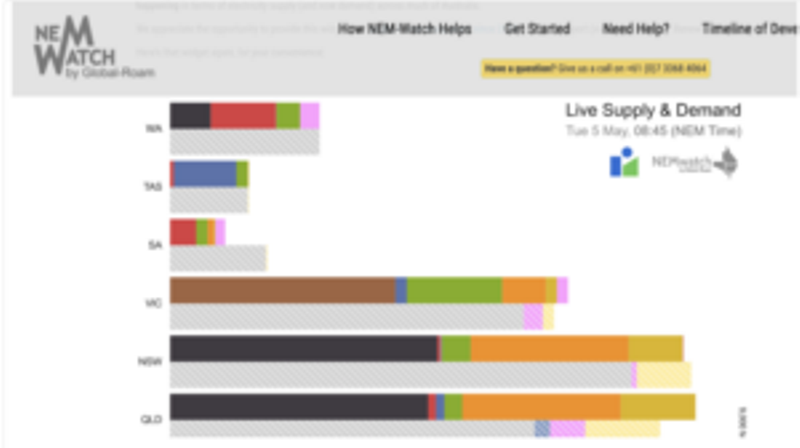
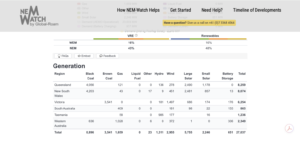
But I am not the only one — take a look at these screenshots below from the National Electricity Market widget. These are from live feeds and are interactive — have a play!
Notice how much yellow and gold (solar power) is showing on the Eastern Seaboard (Queensland, New South Wales, Victoria), and it is morning, the sun has only been up for a couple of hours. These bands will increase as we move towards noon. South Australia and Western Australia are further west, in different time zones, the sun has barely risen and so they are still heavily dependent on gas. Tasmania of course is hydro — showoff!
According to Energy Source and Distribution, Q1 2026 record quarterly demand was matched by record renewable power production and a decline in wholesale electricity prices. “Renewable generation supplied 46.5% of total NEM generation, a new Q1 high and up by 4% since Q1 2025.” One sixth of the solar supply came from Australians with rooftop solar (over 4 GW). Wind supplied almost as much again. Wind powered electricity has increased almost 10% year over year.
Despite the misinformation and obstruction provided by conservative politicians funded by the fossil fuel industry, Minister for Climate Change and Energy Chris Bowen is pushing Australia’s grid transition. He says the grid is making steady progress. “Our plan has two parts: More cheaper, cleaner energy and a better deal for households,” Bowen says. “We’ve got the best sun and wind in the world, and we’re using our sovereign renewables to shield our grid from global energy volatility and to bring down your energy bills.” Reduced generation powered by coal and gas have led to a 12% reduction in wholesale electricity prices. Households do not appear to be receiving the solar and wind discount yet.
“We can also see the impact of Cheaper Home Battery revolution — with more than 350,000 household batteries now displacing gas in the evening with cheap solar, helping the grid for everyone,” Bowen continues. More than 10 GWh of home storage have been installed so far.
ESD tells us that “Total coal-fired generation fell to a new Q1 low of 13,102 MW, down 4.4% from Q1 2025, while gas-fired generation averaged 712 MW, down 24% year-on-year and the lowest quarterly average since Q4 1999.”
To put Australia’s home battery installations into a global context, ESD tells us that the “whole of Europe (including the UK but presumably excluding Russia) brought 3.4 gigawatt-hours of grid-scale battery capacity online in the month of March,” which it states was likely to be a record level of monthly capacity for Europe. Globally, over 18 GWh of grid-scale batteries were installed in March. In the same month, Australian households and small businesses installed about 1.65 GWh. Ordinary Australian homeowners are installing batteries at a rate of about 9% “of the total battery capacity installed by power companies across the entire globe, and almost half what Europe managed. Another notable comparison point — Australian household battery capacity installed over March was equal to 19% of the capacity brought online in China over the same month.”
The Australian federal government has now extended the funding for home batteries. So, expect these numbers to get bigger. Initially AU2.3billionwasmadeavailableforsubsidies,butduetomassivetakeupandthefactthathouseholdersareinstallingbiggerbatteries,thefundinghasincreased,byaboutanotherAU5 billion. This is expected to fund cheaper home batteries for the next 4 years. By 2030, the government expects that 2 million Australian homes will have a battery.
The ability for households to store electricity in the middle of the day, when solar output surges, is expected to lower the costs for everyone, not just those with batteries. Peak demand is reduced, and the grid is kept stable.
“Australian households, businesses and community organisations can get a discount of around 30% on the upfront cost of installing a range of small-scale battery systems (5 kWh to 100 kWh).” New regulations have been introduced to encourage homeowners not to overbuild. This should help the funding to go the distance, bigly.
And now for something completely different, as Monty Python would say — a little humorous vignette for those who think the lunatic right have finally come to terms with the renewable energy revolution. Spoiler alert, no, they have not.
From the files of RE Alliance, we have a video for the sceptical. Sheep do co-exist, and quite happily, with solar panels. And solar panels promote fodder growth. See the video here. These videos were posted on Facebook by New South Wales sheep farmer Tony Inder in response to posts from people driving past his Wellington North Solar Farm. They claimed that there were no sheep in amongst the panels. “It’s because you just can’t see under the panels. All those sheep do live under these panels constantly, and you just don’t see them unless we actually get them out in a pile.” So, Tony Inder captured what a muster of 4,200 of his 6,000 sheep looks like from under panels. See the video here.
I was interested to know more about the RE-Alliance, and hope to share more stories from them in the future. Here is what they say about themselves: “RE-Alliance is an independent not-for-profit working to deliver a responsible and rapid shift to renewable energy that actively contributes to the strength of our regions. We listen to and build the capacity of regional communities to lead the shift to renewables. We bring these crucial insights to our advocacy with government and industry, and we centre solutions-focussed, regional voices in the national narrative on renewables.
“RE-Alliance pays respect to First Nations peoples and their elders past and present, who, since time immemorial, have cared for Country. We acknowledge sovereignty was never ceded. We commit to working alongside First Nations peoples to achieve a just energy shift.”
Well that will do for now, the sun is still shining and the wind is still blowing Down Under. Every time we hit a new record for energy production, we get told that’s it, the engines are going to blow (thanks, Scotty), the grid will melt, and civilisation as we know it will cease to exist. But life continues, expected problems are solved, and the goal posts to annihilation are shifted once more. As always, Australia’s future (and that of its sheep) is bright, shady, and electric.
Author: David Waterworth
David Waterworth is a retired teacher who divides his time between looking after his grandchildren and trying to make sure they have a planet to live on.
Source: cleantechnica.com