Cracking soils could accelerate climate change
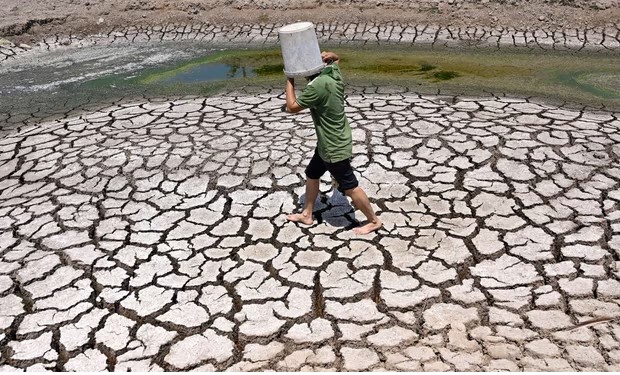
There’s perhaps no more universal image of drought than the crisscross of cracks in parched soil. Soils contract as they dry, rifting the ground—which can allow carbon dioxide and other greenhouse gases to leak out from below.
Now, researchers have proposed that the deeper, more frequent droughts predicted under climate change will lead to more greenhouse gas emissions via soil cracks.
Researchers already knew separately that drought can enhance soil cracking, that soil cracks can enhance greenhouse gas emissions, and that climate change is predicted to make drought more intense and frequent in many arid parts of the world.
“What this paper does is put all that together,” said soil scientist Kelly Caylor of the University of California, Santa Barbara, who was not involved in the new study. It shows how drought-driven changes to the physical structure of soils—in this case, cracking—could contribute to climate change, too, he added.
Soils are the planet’s greatest stockpile of terrestrial carbon. When plants grow, they grab carbon dioxide from the air and capture it as biomass. When animals or other organisms consume this biomass, they break it down into carbon dioxide for energy and release it back to the atmosphere—just as we do every time we exhale. But biomass buried in soils tends to stay there, keeping its organic matter from returning to the air as carbon dioxide. Organic material buried in soil still degrades—it just does so slower than on the surface. Microbes and fungi in soils munch on buried biomass to break it down, releasing some of the trapped carbon as carbon dioxide and sequestering some of the leftovers as a dark, carbon-rich substance called humus, which stays in the soil.
The balance between carbon burial and microbial munching ultimately controls how much carbon soils can store. So anything that gives microbes a boost can speed up the degradation of soil carbon. Generally, microbes eat organic carbon faster when temperatures are warmer.
Historically, soil scientists interested in how climate change affects soil carbon have mostly focused on the effects of temperature, Caylor said. But there’s a growing recognition that drought matters too—as does the physical structure of soils. That includes soil cracks, which Caylor said researchers often view more as a nuisance to be avoided in field measurements than worthy of study in their own right.
A Never-Ending Loop?
When soils dry out and contract, the resulting fissures can be up to a few meters deep, depending on the soil type. (They form most easily in fine-grained, clay-rich soils.) Cracks expose deeper layers of soil to fresh, oxygen-rich air and water—two substances that are like kerosene for microbial metabolism. With plenty of organic material around for soil microbes to degrade, a lack of either water or oxygen is often the only thing holding them back from munching away and releasing soil carbon.
Geotechnical engineer Farshid Vahedifard of Tufts University and his colleagues made the connection between climate change, drought, soil cracks, and greenhouse gas emissions while studying how drought changes soil structure in ways that could threaten earthen architecture such as dams and levees.
“Desiccation cracks due to drought [are] not a new thing,” he said. Neither is oxidation of soil carbon or climate change, he added. “But one thing that caught my attention is the dynamic between these three. And we started looking into that, and I realized that it seemed like there is a feedback loop.”
As the planet’s average temperature climbs, researchers expect drought to intensify and grow more frequent in many arid regions. More droughts would lead to more soil cracks, which would release more carbon dioxide from soils. This extra carbon dioxide, in turn, contributes to climate change—a chain that comes full circle in a self-accelerating feedback loop.
Vahedifard and his colleagues published their study in Environmental Research Letters.
Human greenhouse gas emissions substantially outstrip enhanced carbon dioxide emissions from soil, Caylor said. But, he added, small changes in processes that happen over large portions of Earth’s surface, including many dryland regions, can actually add up to big shifts.
There could be more to the feedback loop than just carbon dioxide, Vahedifard pointed out. “There are several unanswered questions about the dynamics of soil desiccation, cracking, drought, and greenhouse gas emission.” It’s possible that this feedback could involve other greenhouse gases, such as methane and nitrous oxide. And water trickling down cracks into deep soils could also dissolve inorganic, mineral carbon stores—it’s still unclear what effect that would have.
Even given these open questions, the next step is clear, Vahedifard said: quantifying the strength of the feedback loop. If researchers can figure out how much each step influences the next, they’d be in a better place to mitigate its effects. “I believe it has several implications from different perspectives—from climate change modeling to agriculture, land management, and also infrastructure,” Vahedifard said. “This feedback loop has been overlooked.”
Source: eos.org