
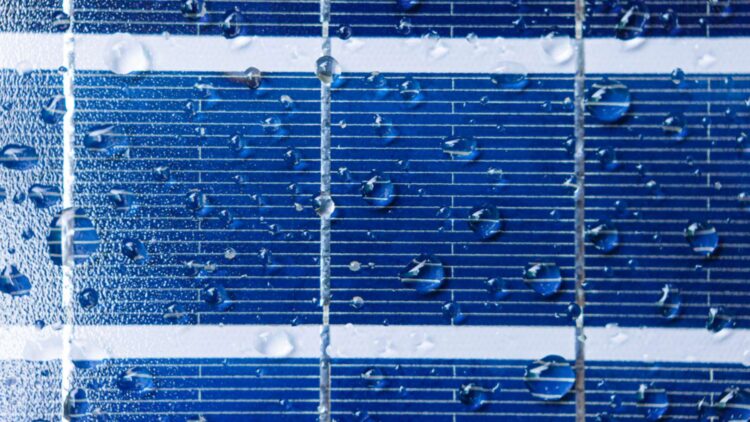
First water-powered solar panel in history turned on: Free, infinite energy at home
Researchers in China have come up with a way to generate electrical power with solar panels that can harvest energy produced by the rain. It has huge potential to overcome the biggest challenge of current solar power systems, which is their inability to function when the sun doesn’t shine. When raindrops fall from the sky and land, they generate a tiny amount of energy that could make a significant contribution to output if collected on a large scale.
New solar panel technology involves harvesting power from raindrops
This new technology out of China is a small-scale version of a hydropower system, drawing on the kinetic power of moving water to generate electrical energy. Researchers aim to develop this as a potential source of renewable electricity to contribute to solar power systems, but its unsuitability for application in large-scale projects to date is a major challenge to overcome.
The raindrop energy collection system works via a device called a triboelectric nanogenerator (TENG), which uses liquid-solid contact electrification to harvest kinetic energy. The same technology can be applied to waves and other forms of liquid-solid triboelectric power systems, but there’s a limitation in connecting these panels, which means reduced output.
Chinese researchers believe they’ve made a leap in TENG tech
A recently published study describes how modeling D-TENG panels (the droplet-based versions) after solar panel arrays makes harvesting raindrop energy more efficient and broadens the technology’s application. Zong Li, a professor at the Tsinghua Shenzhen International Graduate School at Tsinghua University in Shenzhen, China, who was involved in the study, explained:
“Although D-TENGs have ultra-high instantaneous output power, it is still difficult for a single D-TENG to continuously supply power for megawatt-level electrical equipment. Therefore, it is very important to realize the simultaneous utilization of multiple D-TENGs. Referring to the design of solar panels in which multiple solar power generation units are connected in parallel to supply the load, we are proposing a simple and effective method for raindrop energy harvesting.”
In solar innovations closer to home, researchers at Stanford University in the United States believe they’ve got the answer to the biggest problem with solar power generation systems—their inability to work at night. The research team has been working on groundbreaking technology that draws on radiative cooling.
What’s the D-TENG connection problem and is there a solution?
The connection problem involves the unintended coupling capacitance between the panels’ upper electrode and lower electrode that occurs when multiple D-TENGs are connected, which reduces the power output of the D-TENG arrays. To mitigate this effect, researchers have suggested utilizing bridge array generators, which use array lower electrodes. This should, in theory, reduce the influence of the capacitance.
When raindrops make contact with the surface of the D-TENG panel, which is made from fluorinated ethylene propylene (FEP), a phenomenon called triboelectrification occurs whereby energy from the rain is both produced and stored simultaneously. When a droplet hits the surface of the panel, it becomes positively charged while the surface is negatively charged. Li detailed the process:
“The amount of charge generated by each droplet is small and the surface charge on the FEP will gradually dissipate. After a long time on the surface, the charges on the FEP surface will gradually accumulate to saturation. At this point, the dissipation rate of the FEP’s surface charge is balanced with the amount of charge generated by each impact of the droplet.”
When bridge array generators were optimized for raindrop energy collection, the panels were able to operate independently of each other, meaning that unintended power loss was reduced. Li reported:
“The peak power output of the bridge array generators is nearly five times higher than that of the conventional large-area raindrop energy with the same size, reaching 200 watts per square meter, which fully shows its advantages in large-area raindrop energy harvesting. The results of this study will provide a feasible scheme for large-area raindrop energy harvesting.”
It seems likely that with a few more leaps in technology, the Chinese will have a new system to contribute to the country’s dominance as one of those at the top of the renewable energy game, and solar in particular.
Another recent innovation saw China unveiling its most innovative solar power plan ever and it’s so ambitious that it’s caught the attention of renewable energy researchers all over the world. The project involves planting a 0.6-mile-wide solar array 22,400 miles away from the Earth.
Source: ecoportal.net