Lighting the way for renewable energy
A large-scale rollout of solar panels in Tesco stores is a core part of the retailer’s wide-ranging commitment to tackling climate change
Tesco is charging ahead with its renewable energy goals, announcing it will install onsite solar panels at 100 stores over the next three years. The initiative sees the retailer ramp up its commitment to generating clean, traceable energy.
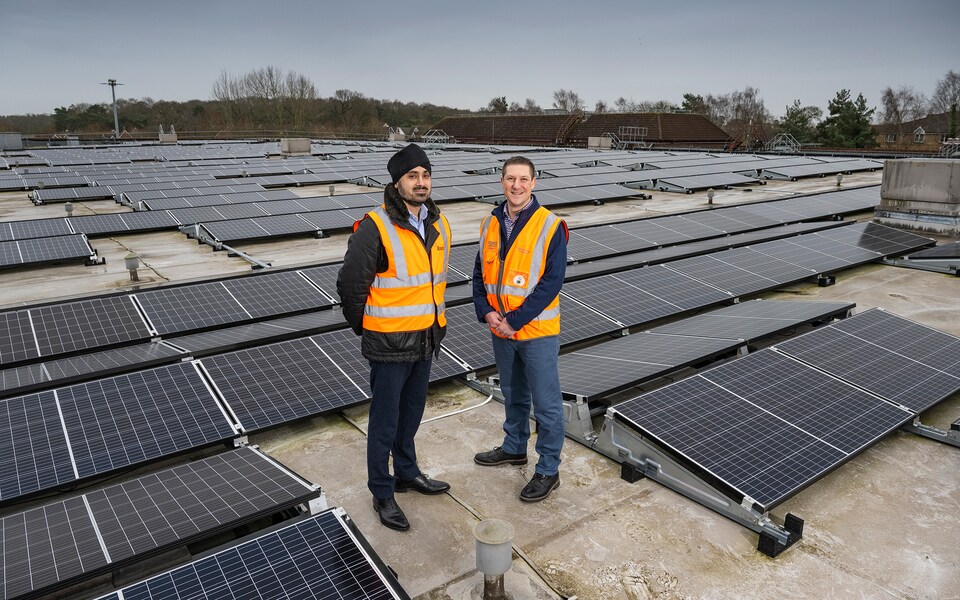
Thetford in Norfolk is the first store to have solar panels installed on its roof in this scaled-up rollout. The superstore has been fitted with more than 1,000 panels as part of a new power purchase agreement (PPA) with renewables investor Atrato Onsite Energy PLC. The panels generate around 30 percent of the store’s electricity consumption, according to Rob Redfern, Tesco’s onsite renewable energy manager.
As well as the obvious economic benefits, generating renewable energy is a key part of Tesco’s pledge to become carbon neutral.
“Setting out ambitious plans to install solar panels on the roofs of 100 of our large stores across the UK over the next three years moves us further towards our target to be carbon neutral in our own operations by 2035,” says Redfern.
“We want to decarbonise the entire estate to become carbon neutral, which means taking out natural gas from our operations. So, we have to generate heat in another way. The more we can do to generate our own power, the more we can do to reduce our reliance on the grid, minimising our exposure to changes in the fluctuation of electricity prices and making us much greener as a business.”
Overall, the rollout to 100 stores could generate as much as 20 GWh of electricity, enough to charge the equivalent of 300,000 Tesco electric home delivery vans.
Forty Tesco stores already have solar panels, which, Redfern says, generated more than 10.5 GWh of electricity last year, equivalent to 3,800 homes.
Gurpreet Gujral, MD of Atrato Partners, says generating its own renewable energy “makes absolute sense” for a large business such as Tesco in more ways than one.
“Tesco has a big footprint with large estates across the country. They’re open all day, and they’ve got scale,” he says. “Installing the solar panels is a straightforward 12-week process, and it’s really a no-brainer for more businesses to do it—not just from an economic perspective, but from a net zero and energy security perspective too.”
Going direct
Tesco has already met its ambition to switch to 100 percent renewable electricity in its own operations by 2030, 10 years early. This was achieved through both direct sourcing and renewable certificates. Now it’s moving to ensure the majority of this renewable electricity comes from direct sourcing.
“The goal is to have around 60 percent of our electricity sourced via onsite or offsite renewable generation,” says Redfern. “That’s the real key focus and a group-wide commitment that we’ve made. We’re in a good place to get there. Powering these 100 stores with solar will really help us kick-start that.”
Why is direct sourcing so important?
“The most traceable way of procuring clean energy is by generating that energy on site,” explains Gujral.
“You could have a large factory in Birmingham, for example, and a solar farm in Cornwall, but that solar energy has to go into the electricity grid, where it becomes essentially mingled together.
“Having direct energy systems gives you confidence and surety that the energy you’re consuming is clean and not from the grid, a network of different energy generation systems, many of which aren’t clean.”
Tesco’s green energy milestones
100 stores will have onsite solar panels installed over the next three years
1,000 solar panels have been installed at the Thetford store
2 GWh of additional electricity will be generated after installation is completed at the Stevenage, Wisbech, Kings Lynn and Stockport stores
60 per cent renewable electricity through direct generation by 2030—the solar panel rollout brings the supermarket closer to its target
10 years early, Tesco met its 2030 ambition to switch to 100 per cent renewable electricity in its own operations across the Tesco Group ahead of schedule
2009: Tesco became the first business globally to set the ambitious goal of becoming zero-carbon by 2050
2019: It accelerated its net zero target in the UK to 2035.
“Tesco in Thetford is just one of nineteen Tesco stores that Atrato Onsite Energy has a PPA with, and it knows exactly how much clean energy it’s consuming because there is literally a private wire that connects the solar PV system directly into each store. So, from a traceability perspective, that’s really important,” says Gujral.
Direct sourcing also takes pressure off the wider national grid infrastructure and boosts energy security. This is likely to become more important as the cost of natural gas becomes increasingly volatile, with prices fluctuating in response to various market forces, including geopolitical tension.
“Renewable energy insulates you from that volatility because you’re generating that energy on your own, and the bulk of the cost of generating it is upfront. Once you’ve made the initial investment, you’re not going to see any change for 10 or 15 years,” says Gujral.
Tesco’s solar panel rollout is part of several new onsite and offsite PPAs it has with renewables investors to increase the amount of renewable electricity it can generate directly. Wind is another source it’s examining.
“Tesco already has some offsite wind farms, and wind may have more of a role to play as we move towards reaching our net zero goals, but that’s something we’re looking at carefully to see what we can and can’t do,” says Redfern.
Thinking outside the (circuit) box
Other ways Tesco is moving towards clean energy use include replacing gas heating boiler stores with air-source heat pumps and replacing diesel vans with electric Dotcom home delivery vans. It has also installed the largest retail network of EV charge points at its stores to help its customers move away from fossil fuel-based transport too.
It is also improving its energy efficiency where it can. All stores are fitted with LED lights, says Redfern, and some stores are also harnessing waste heat from their refrigeration systems.
“We capture the heat that our fridges produce and use it, in effect, as a free source of heat to keep the shops warm,” he says. “We’re looking at different solutions for our over-door heaters and how we can make them more efficient.
“We’re trialling new technologies all the time and always try to innovate as a team. Every store has individual needs that need to be carefully managed, but anything we can do to reduce energy consumption onsite really helps our wider decarbonisation plan.”
Source : telegraph.co.uk